Those Little Arm Bumps: A Realistic Keratosis Pilaris Guide
Quick Answer: Keratosis pilaris - the sandpapery bumps on upper arms and thighs - is keratin plugging hair follicles, driven mostly by genetics and dryness. It is harmless and extremely common. The routine that works: a chemical exfoliant with lactic or salicylic acid a few times a week, a urea or ceramide moisturizer on damp skin daily, lukewarm showers, and zero aggressive scrubbing. Expect visible smoothing in four to six weeks and maintenance forever - and start now, because humid late summer is when skin cooperates most.
Almost half of adults have some version of these bumps, and nearly all of them have spent years attacking the wrong problem - scrubbing at what feels like clogged dirt when it is actually a protein traffic jam with a genetic schedule.


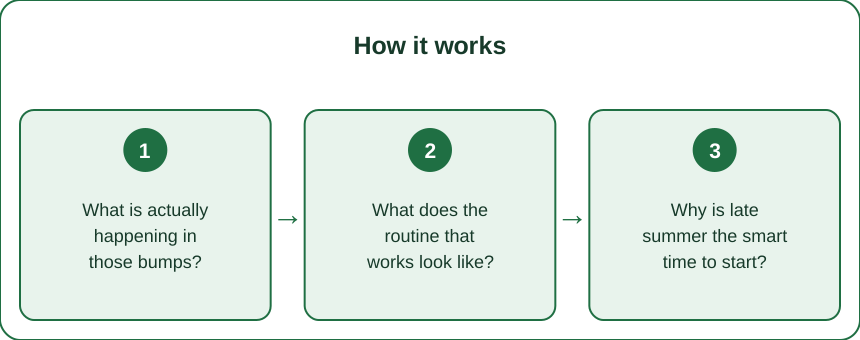
What is actually happening in those bumps?
Each bump is a hair follicle capped by a tiny plug of keratin - the same structural protein that builds hair and nails. For reasons that run strongly in families, the skin around certain follicles produces keratin faster than it sheds, and the excess forms a plug that may trap a fine hair beneath it. Multiply by a few hundred follicles and you get the classic sandpaper texture on the backs of the upper arms, sometimes thighs, cheeks, or bottom - often with pink or brown dots depending on your skin tone.
It is not acne, not an infection, and not a hygiene issue. The bumps do not spread between people or between body parts, and having KP says nothing about how clean you are. It typically appears in childhood or the teens, often improves through adulthood, flares when skin is dry, and calms when skin is hydrated.
That last sentence is the entire treatment logic. You cannot change the genetic keratin schedule, but you can change the two things that decide how visible it is: how efficiently the plugs dissolve, and how hydrated the surrounding skin stays. Those two levers - dissolve and hydrate - are the whole game, and everything that works falls under one of them.
What does the routine that works look like?
Lever one: dissolve the plugs chemically, not mechanically. Two to four evenings a week, apply a leave-on chemical exfoliant to the bumpy areas: lactic acid or glycolic acid loosens the glue between dead cells, and salicylic acid gets into the follicle itself. Body lotions with 10 to 12 percent lactic acid, or a salicylic body spray, are the workhorse formats. Start at twice weekly - daily acid from day one is how people end up red and quit.
Lever two: hydrate like it is the treatment, because it is. Every day, within three minutes of showering, moisturize damp skin. The gold-standard ingredients for KP are urea - which softens keratin directly at 10 to 20 percent - plus ceramides and glycerin. This unglamorous step does as much as the acids.
Supporting rules: showers lukewarm and under ten minutes, because hot water strips the skin oils that keep keratin flexible; a gentle wash, not a squeaky-clean gel; and if you shave the area, a fresh blade with the grain, since irritation feeds the bumps.
The timeline: texture improves before appearance - skin feels smoother around week three or four, looks calmer by week six, and any redness fades slowest. Then maintenance continues at a lazier rhythm indefinitely, because the follicles never got the memo.
Why is late summer the smart time to start?
Because you have a tailwind. Humid August air keeps the skin’s outer layer naturally more hydrated, which means plugs form more slowly and acids work on softer targets. Most people’s KP is at its annual best right now - and at its annual worst in January, when indoor heating turns the air to crackers.
Starting the routine now means you build the habit during the easy season and enter fall already smooth, instead of starting from scratch mid-winter on angry skin. When the air dries out in October, you simply upgrade the moisturizer to a richer cream and keep the same rhythm.
Two summer-specific notes. First, sun: a tan can temporarily camouflage the dots, which tempts people to chase sun exposure as a treatment. The camouflage fades; the sun damage compounds; and several of the acids in your new routine make skin more sun-sensitive - so the areas you treat should be wearing sunscreen when exposed, full stop.
Second, chlorine and salt: pool and ocean days can leave treated skin tight and stripped. A rinse and immediate moisturizer afterward - the same three-minute rule - keeps a swim from undoing a week of progress. None of this requires skipping summer. It only requires the lotion making it into the beach bag.
Myth vs Fact: Strawberry Skin
Myth: Scrubbing harder gets rid of the bumps. Fact: Aggressive physical scrubbing inflames the follicles and makes KP look angrier. Mild physical exfoliation is fine as a supplement, but chemical exfoliants do the actual plug-dissolving, gently.
Myth: KP means you are not exfoliating or washing enough. Fact: It is genetic keratin overproduction, not residue. Some of the most diligent scrubbers have the reddest KP - because of the scrubbing.
Myth: It can be cured permanently. Fact: It can be managed to near-invisibility, and often fades with age on its own, but the tendency is written in. Stop the routine and the texture drifts back over weeks - which is also proof the routine was working.
Myth: Tanning treats it. Fact: Tanning hides the contrast temporarily while adding damage, and KP outlasts every tan.
Myth: Only teenagers get it. Fact: It peaks in adolescence but plenty of adults carry it, and hormonal shifts, dry climates, and low-humidity winters can wake it up at any age.
FAQ: Keratosis Pilaris Questions, Answered
How long does it take to see results treating KP?
Smoother texture in three to four weeks of consistent care, visibly calmer skin around six. Redness and dark dots fade slowest - months, not weeks.
What ingredient is best for KP on arms?
The combination beats any single hero: lactic or salicylic acid a few times weekly to dissolve plugs, plus a daily urea or ceramide moisturizer on damp skin. Consistency outranks concentration.
Can I use a body scrub on strawberry skin?
A gentle one occasionally, on well-moisturized skin, as texture polish - never as the main treatment, and never hard enough to redden. If your skin is flushed after, it was too much.
When should I see a professional about arm bumps?
If bumps are painful, spreading fast, pus-filled, intensely itchy, or simply not what this article describes, get them looked at - several conditions imitate KP. A dermatologist can also prescribe stronger options when the standard routine plateaus. This is general information, not medical advice.
TL;DR:
- KP is genetic keratin plugging follicles - common, harmless, and unrelated to hygiene.
- The routine is two levers: chemical exfoliation a few nights weekly, urea-or-ceramide moisture on damp skin daily.
- Stop scrubbing hard and cool the showers - irritation is the accelerant.
- Start in the humid season, expect four to six weeks, and keep a lazy maintenance rhythm forever.
The bumps respond to boring consistency and to nothing dramatic. Two products, three minutes after the shower, and by the time sweater season arrives the sandpaper will mostly be a memory you check for out of habit.
Keep Reading
This article is for general informational and styling purposes only. Fit, sizing, and product availability may vary.