5 Body Skin Shifts to Make as the Air Dries Out
Quick Answer: As humidity drops, the same routine that worked in summer starts stripping rather than balancing. The five changes that matter most: shorter cooler showers, a richer occlusive layer, applying to damp skin, easing off exfoliation, and adding a humidifier. Do them in that order.
Your skin was fine in July.
It is now week two of tight, itchy shins and you have changed nothing.
That is the point — nothing changed, and the air did.

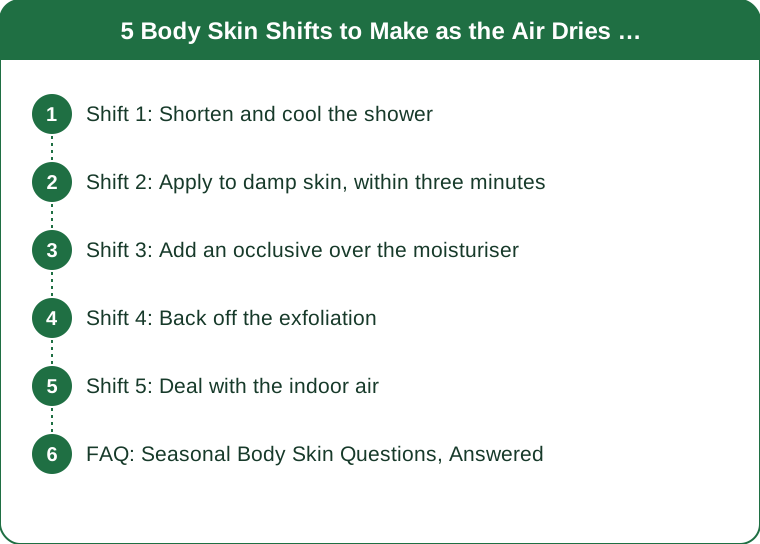
Shift 1: Shorten and cool the shower
This is the highest-impact change and the one most people resist.
Hot water strips the lipids in the skin barrier — the fats that hold moisture in between cells. In humid weather that damage is partly offset by the ambient moisture. In dry air, there is nothing to offset it, and the same shower that felt restorative in August leaves you tight in September.
The practical target: under 10 minutes, at a temperature you would describe as warm rather than hot. If your skin is pink when you get out, the water was too hot.
Also worth changing: the cleanser. Foaming body washes with high surfactant loads do the same lipid-stripping job as hot water. A cream or oil-based wash cleans adequately for most bodies and leaves the barrier considerably more intact.
Do this one change alone for a week before adding anything else, because it often resolves a surprising amount of mild seasonal dryness by itself.
Shift 2: Apply to damp skin, within three minutes
Timing matters more than product here.
Moisturiser applied to bone-dry skin has to supply all the water it is meant to hold. Applied to skin that is still slightly damp from the shower, it traps the water that is already there — which is a far more efficient mechanism and produces a noticeably better result from the same bottle.
The window is roughly three minutes. After that, transepidermal water loss has already carried off most of the surface moisture.
Practically: pat dry rather than rubbing dry, leave the skin slightly tacky, and apply immediately. Keep the lotion in the bathroom rather than the bedroom so the walk does not cost you the window.
This is free, takes no extra time, and produces a bigger visible difference than upgrading to a more expensive product. If you only change one habit this season, this is the one with the best return per unit of effort.
Shift 3: Add an occlusive over the moisturiser
Moisturisers do three different jobs and most bottles are heavy on one of them.
Humectants — glycerin, hyaluronic acid, urea — pull water into the skin. Excellent in humid weather. In dry air with no ambient moisture to draw from, a humectant-heavy product can actually pull water from deeper skin layers and make things worse.
Emollients — ceramides, fatty acids, squalane — fill the gaps between cells and smooth the surface.
Occlusives — petrolatum, shea butter, lanolin, dimethicone — form a physical barrier that slows water loss.
Summer routines lean humectant. Autumn routines need occlusive on top. In practice: your usual lotion, then a thin layer of something genuinely greasy over the worst areas — shins, elbows, forearms, heels. Petrolatum reduces water loss by around 98 percent, which nothing else matches.
Do the occlusive layer at night, when the aesthetic downside does not matter.

Shift 4: Back off the exfoliation
The instinct when skin gets flaky is to scrub the flakes off. It is exactly backwards.
Flaking in dry air is a barrier problem — cells are not shedding properly because there is not enough water in the outer layer for the enzymes that break their bonds to work. Removing them mechanically treats the symptom and damages the barrier further, which produces more flaking in four days.
Halve your exfoliation frequency for the transition. If you were using a chemical exfoliant on your body three times a week, drop to once. Physical scrubs are best paused entirely for a fortnight.
Where exfoliation still earns its place is on the specific bumpy or rough areas — the backs of the arms, for instance — and there a gentle chemical exfoliant used once or twice weekly, always followed by moisturiser, works far better than any scrub.
Add it back gradually once the tightness is gone, not before.
Shift 5: Deal with the indoor air
The outdoor humidity drop is only half the story. The bigger change is what happens when heating comes on.
Central heating warms air without adding moisture, which drops indoor relative humidity dramatically — often to 20 or 25 percent, drier than most deserts. Your skin spends 16 hours a day in that, which is far more exposure than any product can compensate for.
Target indoor humidity is 40 to 50 percent. A cheap hygrometer tells you where you are, and a humidifier in the bedroom is the highest-value purchase in this whole article for anyone with genuinely dry skin.
Cheaper versions that help: drying laundry indoors, keeping the bathroom door open after showering, and lowering the thermostat a degree or two.
If you wake with tight skin and a dry throat, indoor humidity is your problem and no amount of lotion will fully fix it.
FAQ: Seasonal Body Skin Questions, Answered
How long does it take to see a difference?
Barrier repair takes roughly 2 to 4 weeks of consistent care. Surface comfort improves within a few days, but the underlying barrier is slower — do not judge a routine at day five.
Do I need different products or just more of them?
Usually more, applied better, plus one occlusive addition. Wholesale product replacement is rarely necessary and makes it impossible to tell what worked.
Is itchy skin always dryness?
No. Persistent itch, especially without visible dryness, or itch that disturbs sleep, is worth a conversation with a doctor. This is general information, not medical advice.
TL;DR:
- Shorter, cooler showers with a cream cleanser — the biggest single lever.
- Moisturise within three minutes on damp skin, every time.
- Add an occlusive layer at night over shins, elbows, and forearms.
- Halve exfoliation during the transition; flaking is a barrier problem, not a buildup one.
- Get indoor humidity to 40 to 50 percent once the heating starts.
The order matters. Most people start at step three, buy something expensive, and never fix the ten-minute hot shower that is undoing it. Do the first two shifts for a week, then add the rest — you will need less product than you expect, and you will know which change actually did the work.
Keep Reading
This article is for general informational and styling purposes only. Fit, sizing, and product availability may vary.