5 Steps to Repair Body Skin After a Summer of Sun, Salt and Chlorine
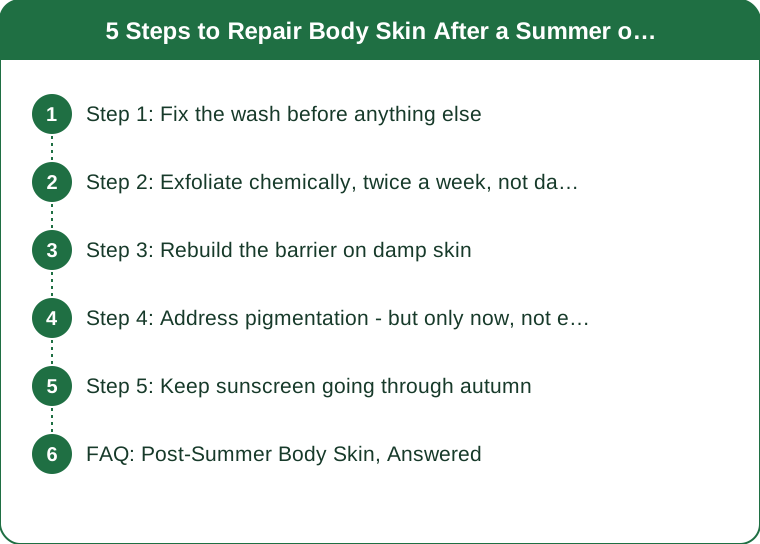
Quick Answer: Repair summer-damaged body skin in this order: switch to a non-stripping wash, exfoliate chemically rather than physically twice a week, restore the barrier with a ceramide or urea cream on damp skin, treat pigmentation only after the barrier is repaired, and keep using sunscreen through autumn. Order matters - exfoliating or using actives on a compromised barrier makes everything worse and is the most common mistake.
By mid-August, body skin has been through a lot: UV exposure, salt water, chlorine, sand abrasion, hot outdoor showers, and more shaving than any other time of year.
The result is usually some combination of rough texture, patchy tone, tight dryness that lotion doesn’t fix, and pigmentation that wasn’t there in May. All of it is addressable in about six weeks, but only in the right sequence.
This is general information, not medical advice. Any mole that has changed in size, shape, or colour over the summer should be looked at by a doctor, not treated as a skincare concern.

Step 1: Fix the wash before anything else
This is the least glamorous step and it changes more than any product you’ll buy.
What summer did: chlorine, salt, and repeated washing strip the skin’s lipid barrier - the mix of ceramides, cholesterol, and fatty acids that holds water in. When it’s depleted, water evaporates faster than skin can replace it, and no amount of lotion on top fully compensates.
What to change:
- Swap foaming body wash for a cream or oil cleanser. Sulphate-based foaming washes are effective and stripping, which is a bad trade on already-compromised skin.
- Turn the temperature down. Hot water dissolves skin lipids directly. Warm, not hot, and this genuinely matters.
- Shorten the shower to five minutes. Extended contact with water paradoxically dehydrates skin by disrupting the barrier.
- Rinse immediately after swimming, in fresh water, before chlorine dries on skin.
- Pat dry, don’t rub, and leave skin slightly damp.
How long before it helps: most people notice reduced tightness within about a week, and that’s before adding a single new product.
The one thing to stop entirely: loofahs and rough exfoliating mitts on dry or irritated skin. Physical abrasion on a compromised barrier causes micro-damage that presents as more roughness, which prompts more scrubbing. It’s a genuine loop and a lot of people are in it.
Step 2: Exfoliate chemically, twice a week, not daily
Summer skin is rough because dead cells aren’t shedding properly - dehydrated skin sheds poorly, and sun exposure thickens the outer layer.
Why chemical over physical: acids dissolve the bonds holding dead cells together and work evenly across the whole surface. Scrubs abrade unevenly - hardest where you press most, which is usually where skin is already thinnest.
What to use:
- Lactic acid - the best all-round choice for body. Exfoliates and hydrates simultaneously, and it’s gentler than glycolic.
- Glycolic acid - stronger, better for stubborn rough patches on elbows and knees, more irritating.
- Salicylic acid - the right choice if you also have body breakouts or keratosis pilaris bumps, since it works inside the pore.
- Urea at 10 percent or higher - both exfoliates and holds water. Excellent for very rough feet, elbows, and shins.
How to use it: apply to clean dry skin, twice a week to start, at night. Not on freshly shaved skin, not on sunburn, not the same day you do anything else active.
What to expect: roughness improves within two weeks, tone within four to six.
The common error: using an acid every day because it’s working. Over-exfoliation presents as tightness, stinging with any product, and skin that looks shiny and thin rather than smooth. If everything you apply suddenly stings, stop all acids for two weeks and go back to step 1.
Step 3: Rebuild the barrier on damp skin
This is the step that determines whether everything else works, and the timing detail is the whole trick.
Apply moisturiser within three minutes of getting out of the shower, onto skin that’s still damp. Damp skin has water at the surface, and an occlusive layer applied on top traps it. The same cream on fully dry skin does substantially less, because there’s less water to hold.
What the ingredients actually do:
- Ceramides - directly replace the lipids that chlorine and hot water stripped. This is the repair ingredient.
- Glycerin and hyaluronic acid - humectants that draw water in
- Urea at 5 to 10 percent - hydrates and gently exfoliates
- Squalane, shea butter, petrolatum - occlusives that seal it in. Petrolatum is the most effective and least elegant.
- Niacinamide - supports barrier repair and helps with tone over time
The practical routine: a ceramide cream everywhere, and something heavier on shins, elbows, and heels, which are the driest areas on almost everyone.
Twice a day beats once. Morning and evening application produces noticeably better results than evening alone, and the morning one matters most if you’re in air conditioning all day - AC is dehydrating in a way that’s easy to underestimate.
Give it two weeks before judging. Barrier repair takes roughly that long, and people typically abandon a good product at day four.

Step 4: Address pigmentation - but only now, not earlier
Sun exposure produces uneven tone, and the temptation is to attack it first. Doing so on a damaged barrier makes it worse.
Wait until the barrier feels normal - no tightness, no stinging, no rough patches. Usually three to four weeks into steps 1 through 3.
What works on body pigmentation:
- Niacinamide at 4 to 5 percent - the gentlest effective option, works on how pigment transfers to skin cells
- Alpha arbutin - inhibits pigment production, low irritation
- Vitamin C - effective and less stable; a body formulation you’ll actually use consistently beats an elegant face serum you won’t
- Retinoids - the most effective for both tone and texture, and the most irritating. Start twice weekly on body, and expect three months before real change.
- Continued lactic acid - fades pigment gradually through cell turnover
Realistic timelines: surface pigmentation improves in 6 to 12 weeks. Deeper pigment takes months. Anything promising a fortnight is describing exfoliation, not pigment reduction.
The most important part: sunscreen. Treating pigmentation while continuing to expose the area to UV is spending money to stand still. September and October UV is lower than July’s but far from negligible, and pigmentation responds to it readily.
On body areas that get missed: chest, backs of hands, and shins accumulate the most cumulative damage and get the least sunscreen. Those three are where the visible difference shows up first, in either direction.
Step 5: Keep sunscreen going through autumn
This is the step everyone drops in September and it’s the one that protects the previous four.
Why it matters after summer: UVA - the wavelength most associated with pigmentation and photoageing - stays relatively high through autumn and penetrates cloud and glass. The visible tanning wavelength drops off in autumn far faster than the ageing one does, which is why skin can keep accumulating damage on days that don’t feel remotely sunny.
A realistic autumn approach:
- Daily on face, neck, chest, and backs of hands. These four are exposed year-round and show damage first.
- Full body only when you’re actually outside for a stretch - a walk, a hike, a match
- SPF 30 minimum, and a formula you’ll genuinely reapply
The chest specifically deserves attention. It gets substantial cumulative exposure through V-necks and open collars, has thinner skin than the face, and is where sun damage tends to show most obviously over decades. It’s also the area people most consistently forget.
Where to keep the routine going: the whole five-step sequence is worth continuing through autumn and winter rather than treating as a repair project. Central heating from October onward is roughly as dehydrating as a summer of chlorine, so the barrier work never really stops being useful.
One realistic expectation: six weeks of this produces a genuinely noticeable change in texture and tightness, and a more gradual change in tone. Pigmentation is a months-long project, and the sunscreen is what determines whether those months are spent making progress or maintaining.

FAQ: Post-Summer Body Skin, Answered
Why is my skin dry even though I moisturise daily?
Almost always the wash or the timing. A stripping foaming wash undoes the moisturiser, and applying to fully dry skin loses most of the benefit. Fix the wash and apply within three minutes of the shower before changing the cream.
Can I use my face products on my body?
Ingredients-wise yes, cost-wise no. Body needs far more product per application, and body skin is thicker and generally tolerates higher concentrations. Buy body-appropriate sizes or you won’t apply enough.
How long until sun spots fade on their own?
Superficial ones often fade partly over several months with strict sun protection. Deeper ones can persist for years. Active treatment speeds it up considerably, but sun protection is doing most of the work either way.
Is body acne after summer normal?
Very - sweat, sunscreen, and occlusive clothing are a reliable combination. Salicylic acid wash and showering promptly after workouts handles most of it. Small itchy uniform bumps that appear after sun exposure specifically are worth having looked at rather than treating as acne.
TL;DR:
- Order matters: wash, then exfoliate, then repair the barrier, then treat tone, then protect
- Swap foaming wash for cream, turn the temperature down, keep showers to five minutes
- Chemical exfoliation twice weekly - lactic for most people, salicylic if you get body bumps
- Moisturise within three minutes of the shower on damp skin, ceramides plus an occlusive
- Don’t touch pigmentation until the barrier feels normal, usually three to four weeks in
- Keep sunscreen on face, neck, chest, and hands right through autumn
Six weeks of the right sequence undoes most of a summer. Doing the same steps in the wrong order is why last year’s attempt didn’t work.
Keep Reading
This article is for general informational and styling purposes only. Fit, sizing, and product availability may vary.