5 Body-Skin Fixes for a Fall Full of Gym Showers
Quick Answer: The problem is not the gym, it is the frequency - five hot showers a week with a foaming body wash strips the skin barrier faster than it rebuilds. Five fixes: lower the water temperature and shorten the shower, swap the foaming wash for a non-foaming or syndet cleanser and only use it where you need it, apply moisturizer to damp skin within three minutes, keep a barrier product for the friction spots, and rinse chlorine or sweat off promptly rather than sitting in it. All five are habit changes, not purchases.
Everyone moves training indoors in September and everyone’s skin gets worse in October. It is not the season doing it - it is the shower count.

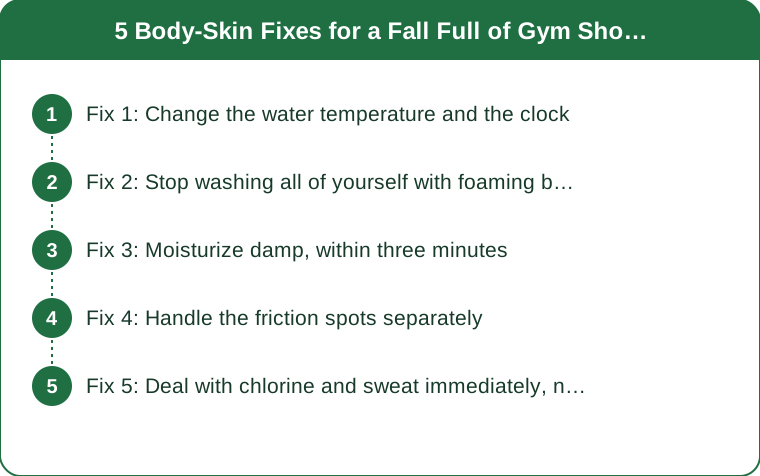
Fix 1: Change the water temperature and the clock
Hot water strips the lipids that hold the skin barrier together. This is the single largest factor in shower-related dryness, and it is free to fix. Lukewarm rather than hot, and the difference in how skin feels shows up within a week.
Cut the duration to five to ten minutes. Prolonged water exposure - even lukewarm - swells and then dehydrates the outer layer of skin. A long hot shower after a hard session is a genuine pleasure and it is also the most damaging thing in this article.
Pat dry, do not rub. Rubbing with a towel is mechanical irritation on skin that has just been softened. Pat until damp, not dry - which sets you up for Fix 3.
The signal you have got this wrong: tightness. Skin that feels tight immediately after a shower has lost too much of its barrier. That sensation is the most reliable at-home indicator there is.
And be realistic about gym showers specifically. You often cannot control the temperature well, and standing under a hot communal shower in an over-air-conditioned building is a strong temptation. If you cannot control it there, shorten the time instead - the two variables are somewhat interchangeable.
Fix 2: Stop washing all of yourself with foaming body wash
Most of your body does not need surfactant every day. The areas that genuinely need cleansing - underarms, groin, feet, and anywhere heavily sweaty - are a small fraction of your surface area. Arms, legs, chest, and back mostly need water.
Foaming washes with sulfates are effective and aggressive. They remove sebum thoroughly, which is exactly what they are designed to do and exactly the problem when used head to toe five times a week.
Switch to a syndet or non-foaming cleanser. Synthetic detergent bars and cream cleansers are formulated to clean at a gentler pH and with less lipid stripping. They lather less, which reads as less effective and is not.
Retire the loofah and the exfoliating gloves for daily use. Mechanical exfoliation on top of daily surfactant is a double hit on the barrier, and loofahs held in a humid bathroom are a well-known bacterial reservoir. Once or twice a week at most, with a clean tool.
Keep body wash in the gym bag for the parts that need it and skip the rest. This sounds absurdly simple and it is the change with the most immediate effect for most people.

Fix 3: Moisturize damp, within three minutes
The three-minute rule is the highest-return habit in body skincare. Applying moisturizer to skin that is still damp traps the water in the outer layer, which is where the hydration benefit comes from. Applying it to fully dry skin twenty minutes later does substantially less.
Choose by ingredient class, not by marketing. You want three things: a humectant that draws water in, such as glycerin or hyaluronic acid; an emollient that smooths, such as squalane or a plant oil; and an occlusive that seals, such as petrolatum, shea butter, or dimethicone. Most decent creams contain all three.
Ceramides are worth looking for specifically. They are a structural component of the skin barrier and topical ceramide-containing moisturizers have reasonable evidence behind them for barrier repair.
Cream or ointment over lotion for autumn. Lotions are mostly water and evaporate; creams and ointments have a higher oil fraction and hold. Save the light lotion for summer.
Keep a tube in the gym bag, not just at home. The gap between showering at the gym and getting home is exactly the window in which the benefit is lost. A small tube in the bag is the whole intervention.
For fragrance-sensitive or reactive skin, choose fragrance-free rather than unscented - unscented products sometimes contain a masking fragrance.
Fix 4: Handle the friction spots separately
Chafing, folliculitis, and breakouts are a different problem from dryness and need different products. Treating everything with body lotion misses this entirely.
Inner thighs, under the sports bra band, underarms, and along waistbands are the standard friction sites. Autumn makes them worse because you are layering more and training indoors in warmer air.
Use a barrier balm or an anti-chafe stick before training, not after. Prevention is far more effective than treating the resulting irritation, and a friction site that gets damaged repeatedly develops thickened, darkened skin over time.
Get out of wet kit promptly. Sitting in damp training clothes after a session is the single biggest contributor to folliculitis and back or chest breakouts. Change immediately, even if you are showering later.
For back and chest breakouts specifically, a wash containing salicylic acid or benzoyl peroxide used two or three times a week on those areas only - not all over - is the standard approach. Leave it on for a minute before rinsing so it can actually work, and be aware that benzoyl peroxide bleaches fabric, including towels and dark training gear.
And check your laundry. Fabric softener residue on technical fabrics traps bacteria and irritates skin. Skip it on training clothes entirely and wash them promptly rather than leaving them in a bag.

Fix 5: Deal with chlorine and sweat immediately, not eventually
Chlorine strips the skin barrier substantially, and if your indoor training involves a pool, this becomes the dominant factor rather than the shower itself.
Rinse before you swim. Skin saturated with clean water absorbs less pool water, the same principle that applies to hair. Ten seconds under the shower before entering the pool is a genuine reduction in exposure.
Rinse immediately after, at the facility. The interval between exiting the pool and rinsing is when chlorine sits on skin doing damage. Rinse before you change, not when you get home.
Moisturize while damp afterward, as in Fix 3. Pool environments feel humid and give a false sense that skin is hydrated; it is not.
For sweat rather than chlorine, the same urgency applies. Sweat left on skin under clothing in a warm room contributes to irritation and breakouts. If you cannot shower straight after a session, a quick wipe-down of the friction and sweat-prone areas plus a full change of clothes handles most of it.
Watch for the things that are not just dryness. Persistent itch, a rash that spreads, skin that is cracking or weeping, painful lumps, or anything that does not improve after two weeks of the changes above is worth showing to a doctor or a dermatologist. Eczema, fungal infections, and folliculitis all look like dry skin to a non-specialist and all need different treatment.
This is general information, not medical advice. Persistent or worsening skin problems, and anything painful or spreading, should be assessed by a healthcare professional rather than managed with moisturizer.
TL;DR:
- The problem is shower frequency, not the gym - five hot showers a week strips the barrier faster than it rebuilds.
- Lukewarm water, five to ten minutes, pat dry rather than rub; tightness after showering is the warning sign.
- Use a gentle syndet or non-foaming cleanser and only on the areas that need it, and retire the daily loofah.
- Moisturize damp skin within three minutes with something containing a humectant, an emollient, and an occlusive - keep a tube in the gym bag.
- Handle friction spots with a barrier balm before training, change out of wet kit immediately, and rinse chlorine off at the facility rather than at home.
None of this requires a new product line. It requires cooler water, less soap on fewer places, and lotion applied three minutes earlier than you currently apply it.
Keep Reading
This article is for general informational and styling purposes only. Fit, sizing, and product availability may vary.