Dry Brushing: Five Minutes of Scratchy Bliss, Explained Honestly
Quick Answer: Dry brushing is a 5-minute, pre-shower ritual where you sweep a firm-bristled brush over dry skin in long strokes toward your heart. It genuinely exfoliates dead skin and gives you a temporary circulation boost and glow — it does not “detox” your body, melt fat, or erase cellulite, no matter what the marketing claims.
The bathroom drawer has a brush in it that looks like something you’d use on a horse, and for the first week you honestly weren’t sure you were using it right. Then you tried it before a shower — long strokes, dry skin, a little scratchy, a lot satisfying — and watched your legs go faintly pink and glowy. That part is real. The detox claims plastered all over the internet? Not so much. Here’s the honest, no-fluff version of what dry brushing does, what it doesn’t, and how to actually do it.

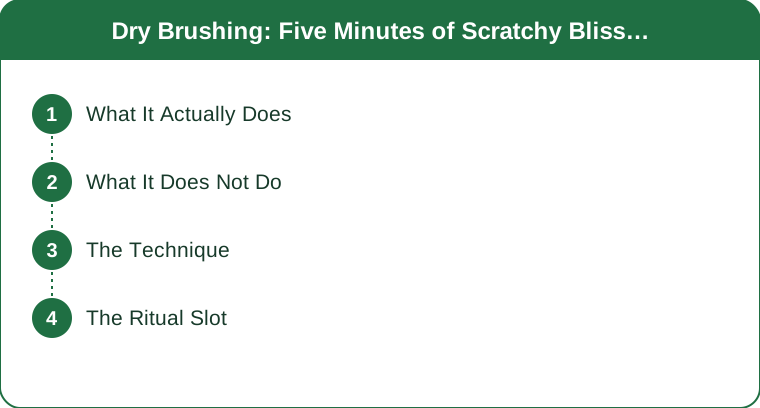
What Does Dry Brushing Actually Do?
Strip away the hype and you’re left with a shorter — but still genuinely worthwhile — list. Physical exfoliation is the biggest one: the bristles slough off dead skin cells, which is why your skin feels smoother and looks brighter almost immediately after. Second is a temporary circulation boost. The brisk brushing motion brings blood to the surface of your skin, which is what causes that pink, warm flush.
Third, and maybe most underrated, is the ritual itself. Five focused minutes of doing something purely for yourself before the day starts is a genuinely pleasant way to wake up your nervous system, even before the water turns on. None of that requires exaggeration to be worth your time.
Does Dry Brushing Really “Detox” Your Body?
Short answer: no, and that’s okay. Your liver and kidneys handle detoxification around the clock, free of charge, with zero input from a bristle brush. Dry brushing doesn’t flush toxins, and it doesn’t shrink fat cells either — cellulite is a structural feature of how fat, connective tissue, and skin interact, and no amount of brushing changes that structure.
It also won’t replace exercise. The lymphatic system does have an actual “pump,” but that pump is muscle movement and deep breathing, not a brush. Think of dry brushing as a nice bonus habit that sits alongside exercise and hydration, not a shortcut around them.
How Do You Dry Brush the Right Way?
The technique matters more than people expect, and it’s simple once you know it:
- Start dry. Always brush before you shower, on completely dry skin — wet skin drags and can irritate.
- Brush toward your heart. Long strokes from your ankles up toward your torso, and from your wrists in toward your shoulders.
- Keep pressure light. You’re aiming for a rosy pink, not red or scratched-looking skin. If it stings, you’re pressing too hard.
- Skip irritated areas. Broken skin, rashes, sunburn, and healing cuts are all off-limits — brush around them, not over them.
- Follow with moisturizer. Rinse off any dust in the shower, then apply lotion or oil to slightly damp skin to lock in the glow.

How Long and How Often Should You Dry Brush?
Five minutes is the sweet spot for a full-body session — enough time to cover arms, legs, and torso without turning it into a chore. As for frequency, three mornings a week is a realistic, sustainable rhythm that still gets you visible results by the end of the week. Daily brushing isn’t necessary and can be more irritating than helpful, especially on sensitive skin.

Myth vs Fact: Dry Brushing Edition
- Myth: Dry brushing detoxes your body. Fact: Your liver and kidneys already do that job — brushing just moves surface blood and dead skin.
- Myth: It gets rid of cellulite for good. Fact: Cellulite is structural. Brushing can temporarily smooth the look of skin, but it doesn’t change the underlying tissue.
- Myth: Harder pressure means better results. Fact: Light pressure is correct pressure. Pink is the goal; red means you overdid it.
- Myth: It can replace your workout for lymph health. Fact: Movement is still the real lymphatic pump — brushing is a nice extra, not a substitute.
Mini FAQ
Does dry brushing get rid of cellulite?
No — cellulite is a structural feature of fat and connective tissue, and brushes can’t change that. It may temporarily make skin look smoother and more toned right after brushing, but the effect isn’t permanent or corrective.
Can you dry brush every day?
You can, but it’s not required and can irritate skin if overdone. Most people get great results brushing three times a week, which is enough to build the habit without overdoing the exfoliation.
What kind of brush and pressure should you use?
A firm, natural-bristle brush with a long handle (for reaching your back) works best. Use light, gentle pressure — your skin should look pink and feel invigorated afterward, never red, scraped, or sore.
TL;DR
- Dry brushing genuinely exfoliates skin and gives a temporary circulation boost and glow.
- It does not detox your body or get rid of cellulite — that’s marketing, not biology.
- Technique: dry skin, light pressure, long strokes toward the heart, skip irritated areas.
- Aim for 5 minutes, 3 times a week, followed by moisturizer on damp skin.
- Pink skin afterward is the goal; red or stinging skin means to ease up.
Keep Reading
This article is for general informational and styling purposes only. Fit, sizing, and product availability may vary.